Showing posts with label John Dewey. Show all posts

Tuesday, September 6, 2016

September Classic of the Month: The Child and the Curriculum

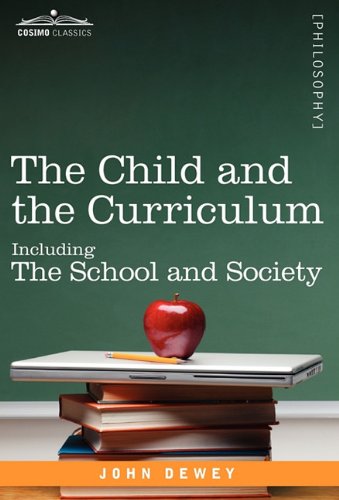
For many children and teachers across the United States, today marks the first day of school! In celebration of new pencils, fresh textbooks, clean notebooks, and little minds eager to learn, we happily present our September Classic of the Month, The Child and the Curriculum by John Dewey.

In a time when memorization and recollection were the primary expectations in a child’s education, John Dewey discovered that essential components lacked within the classroom walls – exploration, curiosity, and ultimately, the ability to experience. He found that how children were expected to learn, greatly differed from the innate learning process we are all naturally inclined to follow— that the growth of knowledge is spurred through manipulation of one’s environment and one’s reflection upon it. It is in his words that readers can grapple the conclusion of his thoughts:“Education is not preparation for life; education is life itself.”

In this fascinating single volume, two of John Dewey’s insightful essays on education in America are presented, which display ground-breaking theory that has provided a foundation to modern education.

About the Author
American educator and philosopher John Dewey (1859–1952) helped found the American Association of University Professors. He served as a professor of philosophy at Columbia University from 1904 to 1930 and authored numerous books, including How We Think (1910),
Reconstruction in Philosophy (1919), and Human Nature and Conduct (1922).

Cosimo Classics is proud to offer this title in both hardcover and paperback at leading online bookstores including Barnes & Noble (paperback, hardcover) and Amazon (paperback,hardcover).



Tuesday, September 29, 2015

September Book of the Month: Democracy and Education

In celebration of the new school year, Cosimo is excited to present Democracy and Education: An Introduction to the Philosophy of Education by John Dewey as its Book of the Month.

John Dewey was one of the most influential figures in the education movement of the early 20th
century. This 1916 volume presents his profoundly revolutionary ideas about how best to teach young minds to be vigorous citizens of a truly democratic society. Reconciling classic philosophies of Rousseau and Plato with the needs and demands of the modern world, Dewey emphasizes critical thinking, problem solving, and learning through practical applications of complex concepts. His efforts were with one goal in mind: to create an integrated, holistic approach to the educational process.

Democracy and Education: An Introduction to the Philosophy of Education is available in ebook and paperback at leading online bookstores, including Amazon (paperback).


About the Author:

John Dewey was an American philosopher, psychologist and educational reformer whose ideas have been influential in education and social reform. Dewey, along with Charles Sanders Peirce and William James, is recognized as one of the founders of the philosophy of pragmatism and of functional psychology. He was a major representative of the progressive and progressive populist philosophies of schooling during the first half of the 20th century in the USA.

Although Dewey is known best for his publications concerning education, he also wrote about many other topics, including experience, nature, art, logic, inquiry, democracy, and ethics.


Tuesday, September 16, 2014

September Classic of the Month: The Child and the Curriculum


Just in time for the start of the school year, Cosimo presents our September Classic of the Month, The Child and the Curriculum by John Dewey.


In a time when memorization and recollection were the primary expectations in a child’s education, John Dewey discovered that essential components lacked within the classroom walls – exploration, curiosity, and ultimately, the ability to experience. He found that how children were expected to learn, greatly differed from the innate learning process we are all naturally inclined to follow— that the growth of knowledge is spurred through manipulation of one’s environment and one’s reflection upon it. It is in his words that readers can grapple the conclusion of his thoughts: “Education is not preparation for life; education is life itself.” 

In this fascinating single volume, two of John Dewey’s insightful essays on education in America are presented, which display ground-breaking theory that has provided a foundation to modern education.


About the Author
American educator and philosopher John Dewey (1859–1952) helped found the American Association of University Professors. He served as a professor of philosophy at Columbia University from 1904 to 1930 and authored numerous books, including How We Think (1910),
Reconstruction in Philosophy (1919), and Human Nature and Conduct (1922). 

Cosimo Classics is proud to offer this title in both hardcover and paperback at leading online bookstores including Barnes & Noble (paperback, hardcover) and Amazon (paperback, hardcover).


Thursday, September 19, 2013

Classic of the Month: The Child and the Curriculum

Students and teachers recently returned to the classroom for a new school year, and in honor of their return to chalkboards, term papers, and exams, we've chosen John Dewey's The Child and the Curriculum: Including, The School and Society as September's Classic of the Month.

The essays that comprise this collection represent two of Dewey's most groundbreaking works on educational reform in the American school system.
"Abandon the notion of subject-matter as something fixed and ready-made in itself, outside of the child's experience."
A prolific philosopher, educational reformer, and professor, Dewey's essays meld his interests into profound philosophical meditations on the relationships between curriculum and student, teacher and student, as well education and democracy. Dewey believed that students should learn by doing: by interacting with the world and relating the concepts of a given curriculum to their lived experience. The ultimate goal of a teacher, Dewey believed, was not to produce a classroom of students with a shared knowledge set, but to produce a classroom of students who would ultimately realize their personal potentials and positively contribute to society.

A seminal work by one of the most respected educational reformers in American history, The Child and the Curriculum is an absolute Must Read for American educators. It is available for purchase in paperback.