Showing posts with label economics. Show all posts

Tuesday, September 18, 2018

September Quote of the Month: The evidence is that the Negro family in the urban ghettos is crumbling

"The evidence is that the Negro family in the urban ghettos is crumbling."

— Daniel Patrick Moynihan


In honor of our Book of the Month, The Moynihan Report, we are highlighten this poignant quote from the lead author, Daniel Moynihan, this September.

Against the backdrop of President Johnson's War on Poverty and the Watts riots in Los Angeles, a young civil servant with the Office of Planning and Research O at the Department of Labor, Daniel P. Moynihan, wrote in 1965 his most controversial study The Moynihan Report - The Negro Family: The Case for National Action.

This report drew widespread attention from critics and supporters alike. It concluded that the conditions under which black children were being raised, generally in single-mother households, were the leading cause of black poverty.

As Moynihan wrote decades later: "The work began in the most orthodox setting, to establish at some level of statistical conciseness what 'everyone knew': that economic conditions determine social conditions. Whereupon, it turned out that what everyone knew was evidently not so."

Although Moynihan was a liberal politician and the report called for jobs programs and vocational training for blacks, many black and civil rights leaders found his report patronizing and that it relied on stereotypes of the black family and black men. 

The 1965 statistics, when approximately 25 percent of black babies were born out of wedlock, have not improved 50 years later, when this percentage has grown to 75 percent; with 50 percent for Hispanic babies and 29 percent for white babies. Also in other areas, such as income, employment, and incarceration, the statistics have deteriorated for blacks. The legacy of The Moynihan Report is that the debate it launched around cultural causes of black poverty is still not settled in modern day America.


Wednesday, January 24, 2018

Astrologer Tamplin on the Wealth of Nations and Transformation of the Global Economy

Ed Tamplin, a respected Australian mundane astrologer, who analyzes political and financial events, wrote this week an interesting horoscope about the Pluto return of the US.  Apparently, at the birth of the US on July 4th 1776, Pluto, the ancient Roman wealth ruler, was placed in the US second house of assets and earning capacity. This placement caused the US to become "the wealthiest nation and the home of modern capitalism."

Tamplin then describes something else important that happened in 1776: "On March 9, a work appeared that would influence financial thinking for centuries after - Adam Smith's classic 'Wealth Of Nations'. Smith was a Scottish philosopher and economist. His magnum opus, appeared at the start of the Industrial Revolution.......This book traces history from the Fall of Rome to the feudal societies, to the mercantile age. Smith argued successfully that wealth was not created by hoarding precious metals, but rather through increasing production and expanding trade. His ideas made gross domestic product, a measure of a country's productive output, part of the fiscal vernacular. Smith also contended that an economy and markets were naturally self-regulating."

So, Tamplin not only links Pluto to the foundation of the U.S., but also to the everlasting influence of this classic book -  by the way while showing the Cosimo Classics cover on Tamplin's website, which is much appreciated. What does this all mean when the US has its Pluto return in 2022? Tamplin believes that this will herald a total transformation of the U.S. and the global economy. Anyone following news events from Brexit to the Trump election, from increasing wealth disparity to unstoppable stockmarkets and the rise of cryptocurrencies, can attest that business as usual no longer applies, and should not be counted on. Brace yourself and be prepared by following websites such as Ed Tamplin's or reading books such as The Wealth of Nations.

Cosimo is proud to offer several editions of The Wealth of Nations, for example two unabridged editions in paperback and hardcover.


And two shorter unabridged editions also in paperback and hardcover.


Thursday, June 15, 2017

June Series of the Month: National System of Political Economy

With all of the political turmoil happening around the world in the last few months (Brexit and the Theresa May election, The Paris Agreement, the James Comey testimony, etc.), we at Cosimo wanted to shine the spotlight on National System of Political Economy by Friedrich List for those readers interested in learning more about collaboration between countries and how it affects us.

One of the most prominent economic philosophers of the 19th century, on par with-but espousing quite different thinking than-Karl Marx and Adam Smith, Friedrich List explores in this three-volume series a reasoned doctrine of national and pan-national management of trade, a global collaboration between government and business. 

Volume 1 examines the pronounced influence of freedom prudently balanced with regulation in the economic histories of the nations of Europe and North America. In Volume 2, he delineates his theory of supportive interconnectedness, discussing everything from the value of the individual's ability to produce wealth to the edge established businesses have over new ones. Volume 3 explores the economic and political systems that nurture ascendant nations in their global sovereignty. 

A close reading of this 1841 classic is an absolute necessity for anyone who hopes to understand world economic history of the last 150 years. 

About the Author
German economist and journalist Friedrich List (1789-1846) served as professor of administration and politics at the University of Tübingen, but was later jailed and exiled to America for his political views. His is also the author of Outlines of American Political Economy (1827). 

Cosimo offers this series by individual volume at leading online bookstores or as a full two-volume set in paperback or hardcover. If you are interested in purchasing the full set, please contact us.

The paperback retail list price for this series is: $34.97, but now our price is: $29.99 (you save $4.98 or a 13 percent discount)The hardcover retail list price for this series is: $68.97, but now our price is: $59.99 (you save  $8.98 or a 13 percent discount)

Tuesday, April 18, 2017

Happy Tax Day!

Wether you are paying the government some overdue taxes or are anxiously awaiting your refund, we at Cosimo are celebrating Tax Day with some awesome classics about that little bit of green that is so important to us. Read these books and learn more on how to manage your money.


On the Origin of Money by Carl Menger

On the Origins of Money is a discussion of the history of money and currency, from its crudest form as cowrie shells, animal pelts, and salt in early societies to the coin and paper money we use today. Rather than focusing on the type or shape of the money, author and economist Carl Menger looks at the reasons behind monetary exchange and why money is so valuable (or where it gets its inherent value). His argument centers on the "saleableness" of the goods or commodities being sold-in other words, the more "saleable" (or valuable or in demand) an item is, the more money it is worth. Hence, money gets its value from the objects it pays for. This short work is an insightful look into the history and value of money for any student or professional economist.


Perhaps America's first celebrated economist, Irving Fisher — for whom the Fisher equation, the Fisher hypothesis, and the Fisher separation theorem are named — staked an early claim to fame with his revival, in this 1912 book, of the "quantity theory of money." An important work of 20th-century economics, this work explores: the circulation of money against goods, the various circulating media, the mystery of circulating credit, how a rise in prices generates a further rise, influence of foreign trade on the quantity of money, the problem of monetary reform, and much more.


The ABC of Money by Benjamin Franklin

From the days of farmer's bartering for bushels of corn to establishing the concept of credit, this practical guide gets at the root of the subject of money: why it exists and, more importantly, what money really is. The ABC of Money is an undiscovered gem offering a wealth of knowledge and Carnegie's shrewd philosophies on the subject — a fascinating look at the history of "debased coin" and "greenbacks," and the value of currency from one of the great American industrialists.


Making Money Happily by Herbert N. Casson

Do your job a little better than expected. Learn all you can from those above you. Waste no time on little things. Back yourself to win. The business advice in this handy little book, first published in 1926, are the bricks that build solid foundations for success, but they're ones that far too many who strive for success forget along the way. Casson, a business journalist, knows wherefrom he speaks: he met and interviewed many of the biggest successes of the early 20th century, and the knowledge and wisdom he gleaned from those meetings is still pertinent today. 


For more books on money, history of currency, wealth, and government reports, be sure to check out our economics page on cosimobooks.com 


Thursday, May 12, 2016

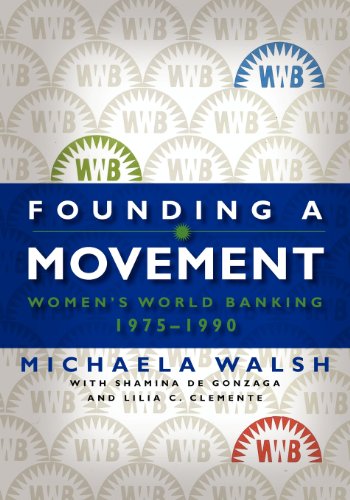
May Book of the Month: Founding a Movement by Michaela Walsh

In celebration of all of those graduating all across the country this month, Cosimo's Book of the Month for May is Founding a Movement: Women's World Banking, 1975-1990, a detailed history of the first global women's microfinance organizations, run by women, for women. Its history is told by founder Michaela Walsh, who was president and CEO of the company from its inception at 1975 until 1990. Chock full of interviews from the organization's first board members and participants, it follows the difficult path WWB took to recognize its dream and make small businesses a reality for so many women around the world.

Founding a Movement shows how hard work and perseverance, not to mention a helping hand from fellow entrepreneurs and business owners, can help anyone take control of their economic destinies. In the words of Michaela Walsh, this book "shines a light on the value that women contribute through work, and when they support one another, to become full participants in the economy through access to financial institutions and services, and everything that goes with that access."

The book has received numerous praises from key business leaders, economists, and international icons. You can read more about it in the official press release, or on the author's website at michaelawalsh.com.
"The power of women teaching one another is profound. Women's World Banking was one of the first movements to realize and trust this truth at a global scale. This is what made it a transforming movement."
-The Honorable Ellen Johnson Sirleaf, president of Liberia and Nobel Laureate
"At last, the full inside story of the founding mothers of microfinance... by one of its key leaders! Indispensable reading!"
-Hazel Henderson, president of Ethical Markets Media and Creator of the Green Transition Scoreboard
"Women's access to finance, including microcredit, is crucial. Michaela Walsh and Women's World Banking have broken new ground. Those who wish to follow in their footsteps should read this story."
-Jan Pronk, former Minister for International Development Cooperation of the Netherlands
About the Author
Michaela Walsh is an activist, scholar, mentor, educator, and author. She has been a pioneer female manager for Merrill Lynch, the first female partner at Boettcher, and the founding president of Women's World Banking. She has taught at Manhattanville College, served on the Boards of several institutions, and was the chairperson of the 59th United Nations DPI/NGO Conference in 2006.She has received numerous awards,including in honor an honor in 2012 from Women's Funding Network for changing the face of philanthropy.


Thursday, May 15, 2014

May Organization of the Month: Praxis Peace Institute


Cosimo would like to highlight the Praxis Peace Institute as our Organization of the Month for May.

Praxis Peace Institute, based in Sonomo, California, is a non-profit peace education organization dedicated to deep inquiry, creative problem solving, and informed civic participation. In bringing together leading educators, researches, activists, and elected representatives, Praxis Peace Institute has established itself as a vehicle for practical workshops, cutting-edge conferences, and civic education. Their goal is to understand the failed mechanisms of the old systems in order to nurture the visions and alternative structures that support the evolution of systemic peace, social justice, and responsible stewardship of our planet.

Since its founding in 2001, Praxis Peace Institute programs have addressed some of the most relevant social challenges of our time. These areas include communication and conflict transformation, inquiries into the effects of culture and propaganda, participatory democracy and peace building, solutions to species' extinctions, and the exploration of what an economic system that supported peace would look like.


Praxis Peace Institute Imprint
Another initiative by Praxis, was when it responded to the libertarian conspiracy film Thrive with a pamphlet titled "Uncivil Liberties: Deconstructing Libertarianism," in which it carefully and concisely laid out the problems inherent in libertarian philosophy and why it is so appealing to today's society. In order to broaden the reach of this pamphlet, Praxis made it into a full fledged book that was published by Praxis's own imprint,  established with the help of Cosimo B2B - see below -.  As we are approaching the congressional elections later this year, this book is a must-read for anyone invested in modern politics and the future of the United States. Uncivil Liberties is available from most online bookstores.


Upcoming Praxis Conference
What: The Economics of Sustainability - Emerging Models for a Healthy Planet
When: October 6-9, 2014
Where: Fort Mason, San Francisco, CA


About: This Praxis conference will showcase the economic and environmental models that have a proven track record in establishing a sustainable relationship with our planet and its inhabitants. Recognizing the severity of the environmental crises we face, the link between economics and environmental policies is a critical factor in achieving sustainable policies and lifestyles. For more information about the conference, panels, speakers, and how to register, please visit Praxis' events page.


Cosimo B2B

Cosimo B2B is Cosimo's services unit, that offers publishing services to organizations such as Praxis Peace Institute, who are considering setting up their own publishing company, in order to reach worldwide readership and enhance their brand name. We welcome those organizations and institutions that are aligned with Cosimo's mission of creating a smarter and more sustainable society by connecting people with valuable ideas. If your organization wants to know more about the benefits of having its own imprint and is interested in working with us to create such an imprint, please visit our private imprint page.


Tuesday, December 4, 2012

United Nations Event Honors Founders of the First Women’s Global Financial Network


Women and men who met in Mexico City in 1975 at the first UN Conference for Women, and resolved to work together to bring women everywhere into the formal financial markets, will be honored at the United Nations on Wednesday, December 5. The event formally launches Founding a Movement: Women’s World Banking, 1975-1990, by Michaela Walsh, one of the founders and the first President of Women’s World Banking (WWB).

Walsh’s book, in her words, “shines a light on the value that women contribute through work, and when they support one another, to become full participants in the economy.” Founding a Movement illuminates the birth of a culture of trust—from Kenya to Colombia, from Brazil to the Philippines—where women entrepreneurs could learn from and teach each other to gain control over their economic destinies. Currently, WWB serves as an umbrella organization to a network of 39 financial organizations from 27 countries that provide small loans, from $100 and up, to borrowers to start their businesses: with a portfolio of $7 billion and $3.5 billion in savings, 26 million clients are served by the WWB network, 80% of whom are women.

The UN event will feature a discussion, moderated by Zohreh Tabatabai, former Director of Communications at the United Nations, recalling the ideas and conditions of 1975—very little knowledge by women across cultures, difficult communications, legal barriers to women regarding credit and bank loans—and reflect on change.  Elements of the process that remain important today include being open to knowledge from all sources, crafting solutions based on grass-roots needs, and providing training as needed rather than by formula.  Of particular importance, according to the book and the founders, is creating a culture of personal trust based on working together.

The event sponsor is the Permanent Mission of the Kingdom of The Netherlands to the United Nations.  Institutions and citizens of The Netherlands played an important role in the history of WWB, which was incorporated there in 1980. According to Walsh, “The trading tradition of the Dutch, and their concern for the interests of women and developing economies, meant that WWB found natural allies in Holland.” The Dutch appreciation for WWB is also evident from the comments by former Minister for International Development Cooperation of the Netherlands, Jan Pronk, who said:

“Women’s access to finance, including microcredit is crucial. Michaela Walsh and Women's World Banking have broken new ground. Those who wish to follow in their footsteps should read this story!"

Among the participants at the UN discussion will be other WWB founders, book contributors, and leading figures in  finance and international development, including Mary Okelo, first African manager of Barclay’s Bank in Kenya and founder of the Makini School; Barbro Dahlbom-Hall, Sweden, management consultant and author; Hon. Dag Nissen, former Norwegian Ambassador; Ron Leger, former Director of the Canadian International Development Agency; Deanna Rosenswig, former Executive Vice- President, Bank of Montreal; Geertje Lycklama, formerly with the Dutch Ministry of Development Cooperation; Klaas Molenaar, formerly with Triodos Bank; and others.  

For more information about the event, please contact Graciela Hall at 516-458-4310.

Tuesday, September 25, 2012

Darwin Gillett, author of Noble Enterprise speaking in Brazil conference on "Profits & Social Values"

Darwin Gillett, author of Noble Enterprise: The Commonsense Guide to Uplifting People and Profits, will speak at conference in Brazil on October 2nd. The conference will be hosted by Fundaceo Dom Cabral, named one of the top ten business schools world-wide by Financial Times for the past three years running. Please check Mr. Gillett's press release, quoted below, for more information.

"While critics of Capitalism, such as the Occupy Wall Street movement, rail against business as a bastion of profit-hungry executives, with little regard for the masses let alone the environment, one Maine businessman has been espousing and documenting an approach for doing business that benefits both profits and social values. This approach helps companies succeed and contributes to a fiar and just society and to the environment."